
Personalizzare il pannello di dettaglio del PivotViewer di Silverlight 5.0
Nell'articolo sul controllo PivotViewer
(https://www.silverlightitalia.com/articoli/silverlight/pivotviewer-v2-silverlight-5.0.aspx),
disponibile nell'SDK di Silverlight 5.0, abbiamo introdotto le possibilità di personalizzazione del layout delle tradecards. Anche il pannello di dettaglio può essere fortemente personalizzato.
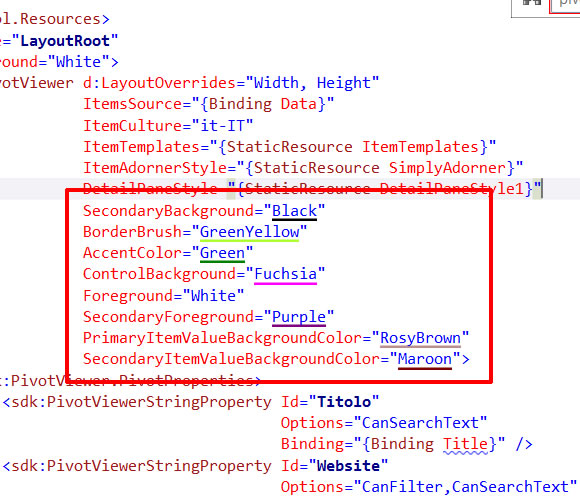
La scelta dei colori si può gestire attraverso le proprietà:
- SecondaryBackground
- BorderBrush
- AccentColor
- ControlBackground
- Foreground
- SecondaryForeground
- PrimaryItemValueBackgroundColor
- SecondaryItemValueBackgroundColo
Con i seguenti valori:
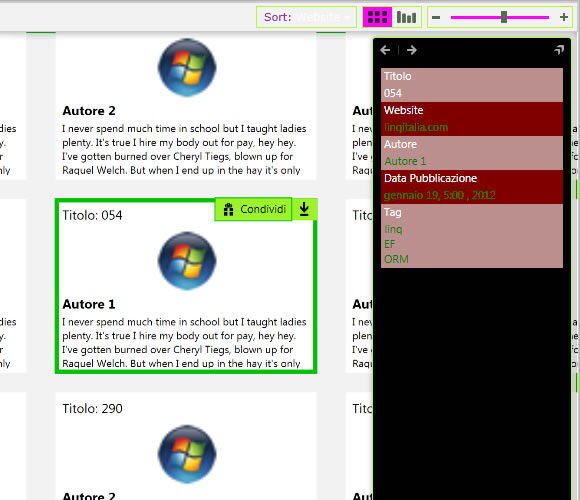
Si può ottenere il risultato seguente:
La barra, inoltre, può essere anche completamente ridefinita: trattandosi del controllo PivotViewerDetailPane possiamo ridefinire il suo Style ed il suo Template.
Ecco un esempio:
<Style TargetType="sdk:PivotViewerDetailPane"
     x:Key="DetailPaneStyle1">
  <Setter Property="Foreground"
      Value="{Binding Foreground,
      RelativeSource={RelativeSource Mode=FindAncestor,
      AncestorType=sdk:PivotViewer}}" />
  <Setter Property="BorderBrush"
      Value="{Binding BorderBrush,
      RelativeSource={RelativeSource Mode=FindAncestor,
      AncestorType=sdk:PivotViewer}}" />
  <Setter Property="AccentColor"
      Value="{Binding AccentColor,
      RelativeSource={RelativeSource Mode=FindAncestor,
      AncestorType=sdk:PivotViewer}}" />
  <Setter Property="Background"
      Value="{Binding SecondaryBackground,
      RelativeSource={RelativeSource Mode=FindAncestor,
      AncestorType=sdk:PivotViewer}}" />
  <Setter Property="ControlBackground"
      Value="{Binding ControlBackground,
      RelativeSource={RelativeSource Mode=FindAncestor,
      AncestorType=sdk:PivotViewer}}" />
  <Setter Property="SecondaryForeground"
      Value="{Binding SecondaryForeground,
      RelativeSource={RelativeSource Mode=FindAncestor,
      AncestorType=sdk:PivotViewer}}" />
  <Setter Property="PrimaryItemValueBackgroundColor"
      Value="{Binding PrimaryItemValueBackgroundColor,
      RelativeSource={RelativeSource Mode=FindAncestor,
      AncestorType=sdk:PivotViewer}}" />
  <Setter Property="SecondaryItemValueBackgroundColor"
      Value="{Binding SecondaryItemValueBackgroundColor,
      RelativeSource={RelativeSource Mode=FindAncestor,
      AncestorType=sdk:PivotViewer}}" />

  <Setter Property="ContentTemplate">
    <Setter.Value>
      <DataTemplate>
        <Grid Width="190">
          <StackPanel Margin="10">
            <TextBlock Text="{Binding Title, StringFormat='Titolo: {0}'}"
                   FontSize="30"
                   Margin="5"
                   HorizontalAlignment="Left" />
            <Image Source="{Binding WebsiteLogo}"
                 Height="150"
                 Margin="5"
                 Stretch="Uniform" />
            <TextBlock Text="{Binding AuthorName}"
                   FontSize="30"
                   FontWeight="Bold"
                   Margin="5,0,5,0"
                   HorizontalAlignment="Left" />
            <TextBlock Text="{Binding Abstract}"
                   FontSize="20"
                   Margin="5"
                   TextWrapping="Wrap" />
          </StackPanel>
        </Grid>
      </DataTemplate>
    </Setter.Value>
  </Setter>
</Style>
Nello Style precedente possiamo vedere come le proprietà della barra vengano prese dai valori impostati sul controllo PivotViewer attraverso le espressioni di binding con RelativeSource e FindAncestor, novità introdotta proprio in Silverlight 5.
Nel ContentTemplate, invece, abbiamo la possibilità di definire tutto il markup per mostrare un layout completamente personalizzato.
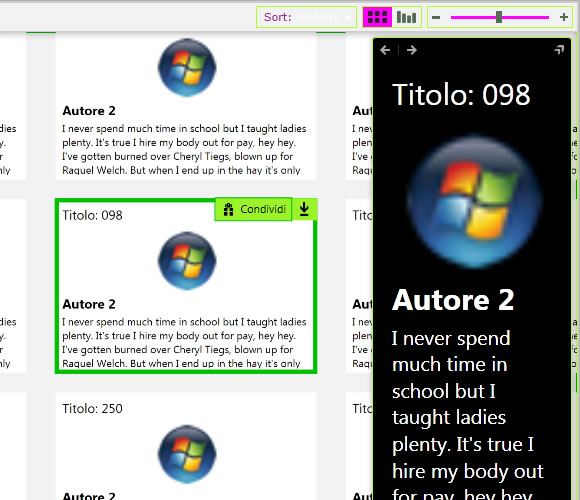
Ovviamente, ridefinendo il ContentTemplate, ci perdiamo le molte funzionalità implementate nativamente dal controllo, che se necessario devono essere reimplementate manualmente.
Commenti

Per inserire un commento, devi avere un account.
Fai il login e torna a questa pagina, oppure registrati alla nostra community.
Approfondimenti
Keynote Global Azure 2026 - ASPItalia.com
Blazor e InputHidden in .NET 10
Ottimizzare la content-visibility in CSS specificando lo spazio da occupato dall'area non renderizzata
Utilizzo del persistent state di Blazor nel prerendering
Integrare il Docker Model Runner in un workflow di GitHub
Monitorare le tabelle di Azure SQL Database con Change Event Streaming
Utilizzare le direttive più importanti in una file based app .NET
Stop alle password con Azure Managed Identity
Creare un extension method per applicare condizionalmente una Where in una query LINQ per Entity Framework
Creare una file based app con C#
Escludere alcuni file da GitHub Copilot
Utilizzare le librerie native di .NET per comprimere uno o più file in formato ZIP

